

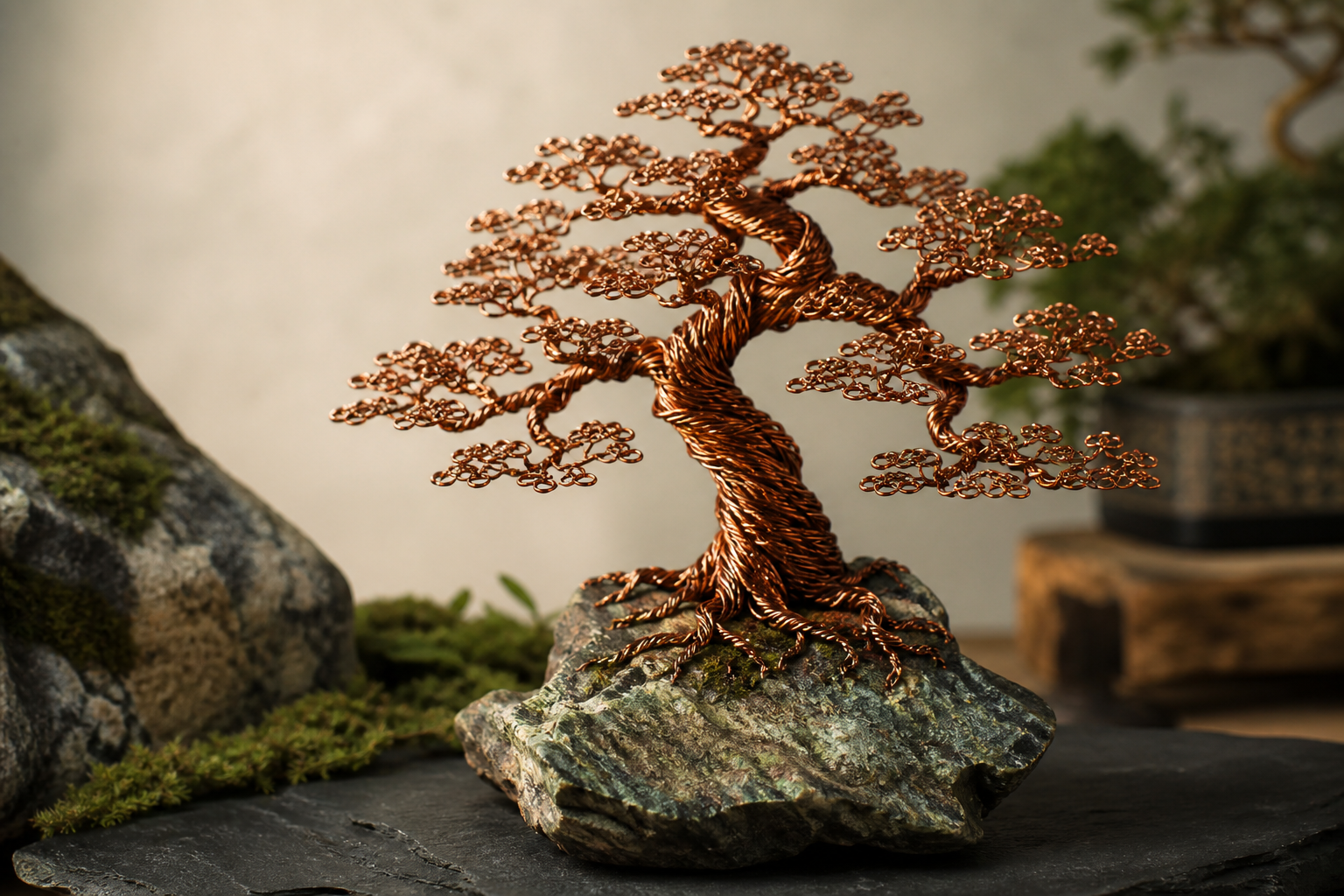
From Copper Wire to Living Art
When most people see a finished wire bonsai sculpture, they see the end result—a miniature tree carefully shaped from copper wire, mounted on a stone, and displayed as a piece of art. What they don’t see are the countless decisions, adjustments, and hours of work that went into creating it.
Recently, I completed a new wire bonsai sculpture and documented the entire process from start to finish. While the finished piece is something I’m proud of, the real story lies in the journey of creating it.
Beginning with a Vision
Every sculpture starts with an idea. Sometimes that idea is inspired by a real bonsai tree, while other times it comes from years of observing nature and imagining how a tree might grow under certain conditions.
Before a single wire is twisted, I spend time visualizing the structure of the tree. I consider the movement of the trunk, the placement of the primary branches, and the overall silhouette. Just as with traditional bonsai, balance and proportion are everything.
Unlike a living tree, wire gives me complete control over the design. At the same time, that freedom creates its own challenges. Every bend, twist, and branch placement must be intentional because there is no natural growth to hide mistakes.
Building the Foundation
The construction process begins with the trunk and root structure.
Dozens of individual strands of copper wire are gathered together and twisted to form the trunk. From there, the wire is separated into smaller groups to create the primary branches, secondary branches, and eventually the fine branching that gives the tree its character.
This stage requires patience. What appears to be simple twisting is actually a constant process of evaluating proportions, adjusting branch placement, and refining movement. A branch that looks perfect from one angle may appear awkward from another.
Much like traditional bonsai styling, the goal is to create the illusion of age, strength, and natural growth.
The Art of Refinement
As the sculpture begins to take shape, the focus shifts from construction to refinement.
This is often my favorite part of the process.
The major structure is already established, allowing me to concentrate on subtle details. Small adjustments to branch angles, spacing, and overall composition can dramatically change the feeling of the piece.
These refinements are often invisible to the casual observer, yet they are what transform a collection of twisted wires into something that resembles a living tree.
It’s a reminder that mastery is often found in the smallest details.
Documenting the Process
Creating the sculpture was only half the project.
Throughout the build, I recorded video footage of each stage so I could share the experience with others. Setting up cameras, capturing different angles, and remembering to document important moments became part of the creative workflow.
There is an interesting challenge in balancing art and documentation. When you’re deeply focused on creating, it’s easy to forget about the camera. Yet documenting the process allows others to experience the journey rather than simply seeing the final result.
The footage becomes a visual record of decisions, mistakes, discoveries, and moments of inspiration.
The Hidden Work: Editing the Video
Many people assume the difficult part is building the sculpture.
In reality, editing the video can be just as demanding.
Hours of footage must be reviewed, organized, trimmed, and assembled into a story that viewers can follow. Music must be selected. Transitions need to feel natural. Pacing must keep the audience engaged while still showing enough detail to teach and inspire.
The editing process is its own form of artistry.
Just as branches are refined on the sculpture, scenes are refined in the timeline. Unnecessary moments are removed. Important details are emphasized. A narrative begins to emerge.
The goal is not simply to show what happened, but to help viewers experience the journey alongside me.
Creating Art and Creating Content
One lesson I’ve learned is that making art and creating content have more in common than most people realize.
Both require patience.
Both require practice.
Both involve solving problems that weren’t obvious when you started.
And both require the willingness to keep refining your work long after the initial excitement has faded.
A finished sculpture represents dozens of small decisions made over time. A finished video represents the same thing.
Neither happens instantly.
More Than a Finished Piece
At the end of the process, I have more than just a wire bonsai sculpture.
I have photographs that document its creation. I have video footage that tells its story. I have lessons learned that will influence future projects.
Most importantly, I have another chapter in an ongoing journey of learning, creating, and sharing the art of bonsai.
The sculpture may be finished, but the process continues.
And that’s one of the things I love most about this art form.
Every project teaches something new, and every finished piece becomes the starting point for the next creative adventure.